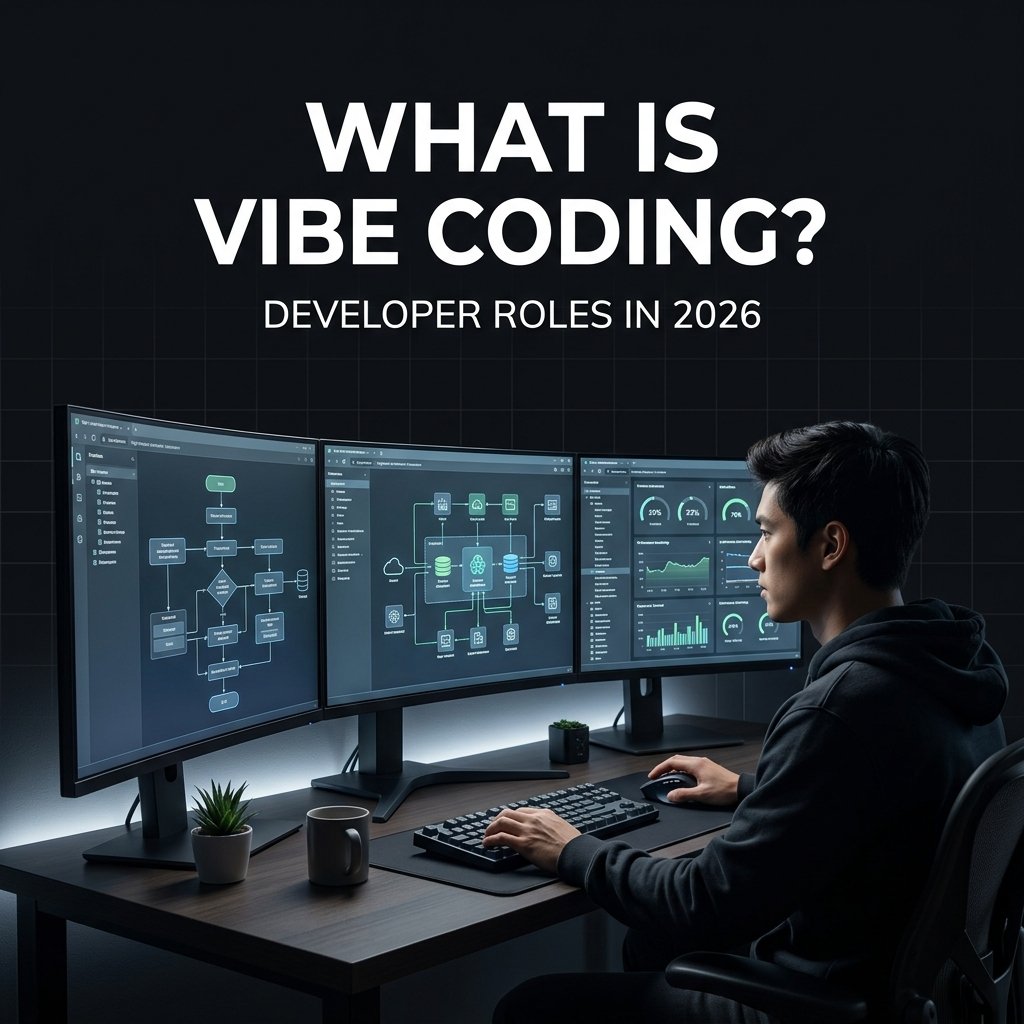
What is Vibe Coding? How AI is Changing Developer Roles in 2026
Published: July 1, 2026 • Written by Alex Rivera • Read Time: 15 min • Word Count: 2,050 words
1. Introduction: The Death of the Syntax Writer
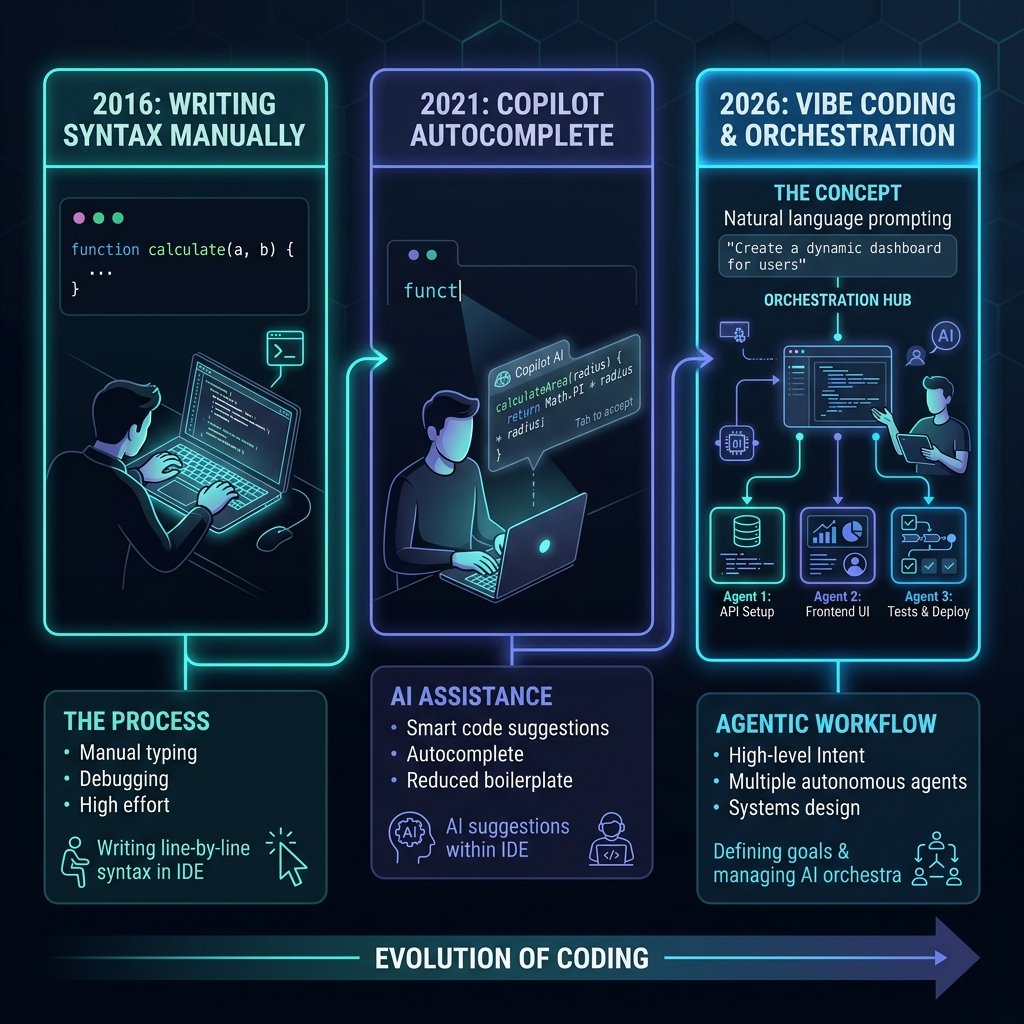
For decades, being a software engineer meant being a master of syntax. It meant spending hours memorizing language specifications, debugging missing semicolons, wrestling with memory allocation, and writing repetitive boilerplate code. A developer's value was heavily tied to their speed and accuracy in translating human logic into lines of code.
In 2026, that definition of a software engineer is officially dead.
With the rise of advanced AI coding agents like Claude Code, Cursor, and autonomous software engineers, the barrier of writing syntax has been completely abstracted away. Developers no longer write code line-by-line. Instead, they "vibe."
Coined as a lighthearted term by prominent AI researchers and tech executives, **"Vibe Coding"** has rapidly evolved into a serious, industry-wide paradigm shift. It describes a new way of building software where the human developer focuses entirely on high-level system architecture, user experience, and product design, while delegating 100% of the actual code generation, testing, and debugging to autonomous AI agents.
In this deep-dive article, we will explore what vibe coding actually is, analyze the psychological shift it requires, and discuss how it is transforming developer roles and career paths in 2026.
2. What is Vibe Coding?
**Vibe Coding** is a software development methodology where the human developer acts as an **orchestrator and director** rather than a manual writer of code.
In a vibe coding workflow, you do not open an empty editor and start typing `import React from 'react'`. Instead, you sit back, think about the system architecture, and describe your vision to an AI agent in natural language.
For example, a vibe coding session might look like this:
While the AI agent is spinning up servers, writing routes, and running tests in a loop, the developer is "vibing"—reviewing the high-level architecture, thinking about edge cases, analyzing user experience, or working on business strategy.
3. The Psychological Shift: From Writer to Director
Transitioning to a vibe coding workflow requires a massive psychological shift for traditional developers. For years, our identity and self-worth have been tied to our ability to solve complex syntax problems. Letting go of the keyboard can feel uncomfortable, even threatening.
However, successful engineers in 2026 realize that **code is just a means to an end.** The ultimate goal of software engineering is to solve problems and deliver value to users.
By abstracting away the syntax writing, vibe coding allows developers to operate at a much higher level of abstraction. You transition from being a **bricklayer** (laying down lines of code) to an **architect** (designing the entire city). This shift dramatically reduces cognitive fatigue and unlocks unprecedented levels of creativity.
In-Content Image Placement
4. How AI is Transforming Developer Roles
As vibe coding becomes the standard, the traditional hierarchy of software engineering roles is being completely restructured:
-
The Junior Developer (The AI Operator):
Junior roles no longer involve writing basic boilerplate or fixing simple CSS bugs. Instead, Junior Developers act as AI Operators—directing AI agents to build features, running test suites, and verifying that the generated code matches the product requirements.
-
The Senior Developer (The System Architect):
Senior Developers focus entirely on system architecture, security guardrails, data modeling, and performance optimization. They ensure that the various AI-generated microservices integrate smoothly and adhere to enterprise security standards.
-
The Software Orchestrator (The New Career Path):
A brand-new role emerging in 2026. The Software Orchestrator is a hybrid role combining product management, system architecture, and AI prompting. They are responsible for managing fleets of autonomous AI agents, directing them to build complex systems, and orchestrating continuous delivery pipelines.
5. Essential Skills for the Vibe Coding Era
To thrive as a software engineer in 2026, you must develop a new set of core competencies:
-
System Architecture & Data Modeling:
You must understand how databases, APIs, caches, and frontend clients interact. If you design a poor database schema, even the smartest AI agent will generate a slow, buggy application.
-
Code Review & Verification:
Since you aren't writing the code, your primary job is to review it. You must be able to read AI-generated code, identify security vulnerabilities, spot performance bottlenecks, and verify that it matches the business requirements.
-
Agentic Prompting & Configuration:
Learning how to write precise, context-rich prompts and configure agent files (like `CLAUDE.md` or `hooks.json`) to guide AI agents to follow your team's specific coding standards.
6. The Dangers of Vibe Coding: Technical Debt & Hallucinations
While vibe coding is incredibly fast, it is not without its risks. If developers rely too heavily on AI without understanding the underlying code, they run the risk of introducing severe **technical debt** and security vulnerabilities:
-
Unchecked Hallucinations:
AI models can occasionally hallucinate NPM packages, API endpoints, or security configurations. If a developer blindly accepts AI changes without reviewing them, they could easily push broken or insecure code to production.
-
The "Black Box" Codebase:
If an entire application is built by AI and the human developers never read the code, the codebase becomes a "black box." When a critical production outage occurs, the team will struggle to debug the issue because no one understands how the system actually works.
-
Dependency Bloat:
AI agents love installing npm packages to solve minor problems. Without strict human oversight, this can lead to massive dependency bloat, slow build times, and an increased security attack surface.
7. Conclusion: Embracing the Future
Vibe coding is not a fad; it is the natural evolution of software engineering. Just as compilers replaced assembly language and high-level frameworks replaced manual memory management, AI coding agents are replacing manual syntax writing.
The developers who thrive in 2026 will not be those who fight this change, but those who embrace it. By mastering system architecture, code review, and AI orchestration, you can leverage vibe coding to build software faster, more securely, and at a scale that was previously impossible.
To start automating your vibe coding workflows today, check out our guide on Claude Code Hooks, or read our in-depth review of Lovable.dev to see how full-stack generators are changing the MVP landscape.
About the Author: Alex Rivera
Founder & Editor-in-Chief, The Byte 404
Alex is a former Senior Systems Architect at Netflix and Stripe with over 15 years of experience building high-throughput distributed APIs. He writes about distributed systems, backend performance, and AI-native engineering workflows.